
Authored By Mr. Sumit Jugran
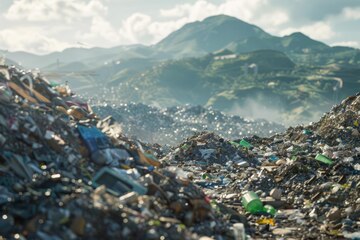
India’s rapid urbanization and industrialization have come with their fair share of growing pains, and nowhere is this more evident than in the towering mountains of waste dotting our cities. These so-called “landfills” have become a permanent fixture in our urban landscapes, but it’s important to clarify that not all of them deserve the name. Let’s start by addressing a crucial distinction the difference between a landfill and a dumpsite.
LANDFILLS VS. DUMPSITES: CLEARING THE CONFUSION Though the terms “landfill” and “dumpsite” are often used interchangeably, they represent starkly different approaches to waste management. A landfill is a scientifically designed facility where waste is carefully treated, managed, and disposed of to minimize environmental and health impacts. Modern landfills are engineered with protective liners, leachate collection systems, and gas extraction mechanisms, ensuring that the waste does not contaminate the surrounding soil, water, or air. In contrast, a dumpsite is a chaotic, unregulated area where waste is simply dumped and left to decay. Without any safeguards, dumpsites become breeding grounds for diseases, emit harmful gases like methane, and leach toxins into the soil and groundwater. Unfortunately,most of what we call “landfills” in India are nothing more than giant dumpsites. The towering garbage heaps of Ghazipur in Delhi, Deonar in Mumbai, and Perungudi in Chennai are tragic reminders of this reality.
MOUNTAINS OF NEGLEСТ
For decades, these waste mountains have grownunchecked, becoming iconic symbols of urban mismanagement. Yet, what’s rarely discussed is the lack of a concrete approach or technology to address the problem. India’s
waste management infrastructure remains woefully inadequate to deal with the 62 million tonnes o municipal solid waste generated annually-a figure that’s only expected to rise as consumption patterns evolve. The Ministry of Housing and Urban Affairs (MoHUA) has frequently cited this statistic in reports on municipal solid waste management in India. PIB India – Urban Waste Management.
We’ve normalized these mountains of garbage to such an extent that they barely feature in public discourse anymore. They’re no longer headline news, and they’ve vanished from political manifestos. During election campaigns, candidates rarely make promises to clean up our cities’ waste. It’s as if we’ve resigned ourselves to living with these mountains, despite the immense toll they take on our environment and health.
AN URBAN DEVELOPMENT CRISIS
The issue of landfills is not just an environmental one; it’s a critical urban land development challenge. With India’s burgeoning population and rising consumption, waste generation is projected to increase exponentially. It has been estimated that by 2030, the area required to store waste could be equivalent to thousands of football fields if current practices persist. By 2050, that figure could double. This isn’t just unsustainable; it’s unthinkable. Urban land is a precious commodity, and using it to store waste instead of for housing, infrastructure, or green spaces represents a colossal opportunity cost. Cities like Bengaluru and Mumbai, already grappling with space constraints, are being forced to look for waste storage solutions outside their boundaries, creating tension with neighboring regions.
WHERE IS THE TECHNOLOGY?
The world has made significant strides in technology, from excelling in Al and machine learning to producing advanced microchips. Yet, when it comes to waste management, we remain woefully behind. Technologies like
waste-to-energy plants, advanced recycling facilities, and Al-based waste sorting systems have been
implemented successfully in countries like Sweden, Germany, and Japan. Why hasn’t India embraced similar innovations? One major hurdle is scale. The sheer volume of waste in India’s dumpsites and landfills is daunting. Legacy waste alonethe accumulated, untreated waste sitting in these dumps for decades-poses a monumental
challenge. Treating this waste requires massive investment, advanced technology, and sustained political will-all of
which are currently in short supply. Legacy waste refers to old, untreated waste accumulated in open dumpsites. The NITI Aayog’s reports have identified the remediation of legacy waste as one of the largest challenges in urban waste management in India. NITI Aayog Urban Waste Report
THE HUMAN COST
The impact of these landfills isn’t limited to the environment; it’s also a significant social issue. Thousands of waste pickers work in these dumpsites under appalling conditions, exposed to harmful gases, sewage, and disease. These individuals play a crucial role in informal recycling efforts, yet they lack basic safety equipment or social security. Child labor is rampant in many of these areas, adding another layer of tragedy. Residents living near dumpsites face equally dire conditions. Fires, often caused by the spontaneous combustion of methane, are common in these areas, releasing toxic fumes that choke the surrounding neighborhoods. The health impacts-ranging from respiratory illnesses to cancerare devastating. The crisis has escalated to the point where it’s not just an environmental or social issue but a full-blown public health emergency.
Reports by the CPCB highlight that open fires in dumpsites release toxic gases like methane, carbon dioxide, and volatile organic compounds, which cause severe health and environmental impacts.
Reference Link: CPCB Reports
THE WAY FORWARD
Addressing the landfill crisis requires a multi-pronged approach that combines technology, policy, and public awareness. Here are some key solutions:
Stricter Waste Segregation at Source: Segregating waste into wet, dry, and hazardous categories at the household level is the first step. Without this, recycling and composting efforts are doomed to fail.
Promoting Composting for Wet Waste: Wet waste, which makes up about 50-60% of municipal solid waste in India, can be composted into nutrient-rich manure. Encouraging community composting initiatives can significantly reduce the burden on landfills.
Enhanced Recycling Infrastructure: Investing in advanced recycling facilities can help recover valuable materials from waste, reducing the amount of residual waste that ends up in landfills.
Advanced Landfill Management Technologies: Technologies like bioremediation, biomining, and wasteto-energy systems need to be scaled up. These solutions can help treat legacy waste and convert it into useful byproducts like energy or construction material.
Raising Public Awareness: Educating citizens about responsible waste management practices is crucial. Campaigns
should focus on reducing single-use plastics, reusing materials, and disposing of waste responsibly.
Strengthening Regulations: Stricter enforcement of waste management rules, coupled with penalties for non-compliance, can drive change at both individual and institutional levels.
Empowering Waste Pickers: Formalizing the role of waste pickers in the waste management ecosystem and providing them with safety gear, training, and fair wages can improve their livelihoods and make the system more efficient.
CONCLUSION
The condition of landfills in India is a reflection of our collective apathy toward waste management. These towering mountains of garbage are more than just eyesores; they’re a testament to our failure to address one of the most pressing challenges of urban living. The solutions are within reach, but they require a concerted effort from all stakeholders-government, industry, and citizens alike. It’s time to stop treating waste as an afterthought and start seeing it as a resource. By embracing innovative technologies, enforcing stricter regulations, and fostering a culture of responsibility, we can transform our waste management system from a liability into an asset. The question is: do we have the will to act before it’s too late?